
How to Search the Lancaster County Court Docket
Start with the JUSTICE one-time name search. It covers both County Court and District Court in Lancaster County. It returns a case summary plus the chronological Register of Actions. Search a party, not a witness. The fee is $17 for up to 30 cases. A new case can take about 24 hours to appear. Note that this public search is a paid service even when it turns up nothing.
Gather the party name first. An approximate year helps too, along with Lancaster County and the court or case type. You can narrow results by County or District Court. Case type and subtype, judge, or attorney also work as filters. For a specific filing, keep the case number the screen displays. Then ask for that exact order or pleading. A calendar entry answers a date question. For the full event history, though, the Register of Actions is the better starting point.
- Choose the likely court: County Court for traffic, misdemeanors, small claims, probate, and felony preliminary matters; District Court for felony trial matters and major civil cases; or the separate Juvenile Court when applicable.
- Run the party-name search in JUSTICE and narrow it with Lancaster County, year, court type, and case type when needed.
- Open the matching result, then record its case number, court, parties, judge, filing date, and listed status.
- Read the Register of Actions in date order and compare the most recent setting or order with the applicable court calendar.
- Contact the appropriate clerk for a public document image that is unavailable, an in-person terminal search, or a certified copy.
The Nebraska Judicial Branch directory for Lancaster County Court names the local court and gives the public a contact route.
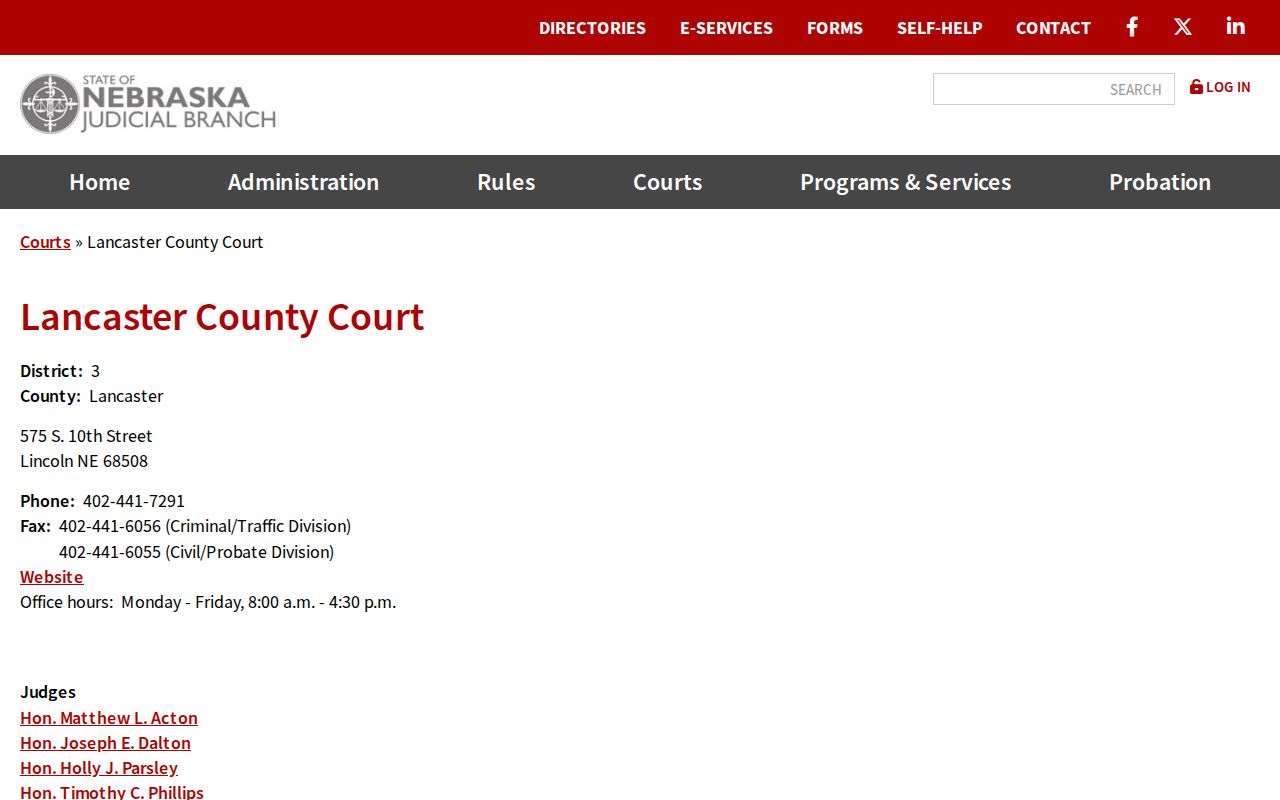
County Court is only one layer of the Lancaster docket system. Let the case type guide the first search, then any follow-up call.
Lancaster JUSTICE Search Versus eFiling
JUSTICE and eFiling serve two different jobs. JUSTICE is Nebraska's statewide trial-court case search. It can pull up a case summary, the parties, costs, payments, the Register of Actions, and any nonconfidential images that are available. Nebraska.gov eFiling is something else entirely. It is a login-based process for submitting documents and getting eService or eNotice. If you just want to see a filed order, start with JUSTICE or the clerk. An eFiling sign-in is the wrong door.
A one-time search keeps its results available for three calendar days. Payment is due even when the search comes back empty. Since January 2024, nonconfidential images filed after April 16, 2008 come included with a one-time search. That cutoff only concerns image availability, not whether a case exists. Older matters may still show a Register of Actions with no digital document image attached.
| JUSTICE search field | Useful Lancaster choice | Why it helps |
|---|---|---|
| Party name | Individual or entity involved in the case | Starts the public name search without using a witness name. |
| County and year | Lancaster County and the likely case year | Reduces broad statewide name results. |
| Court and case type | County or District, plus type or subtype | Separates traffic, civil, criminal, probate, and other records. |
| Judge or attorney | Add only when already known | Further narrows a result list that approaches the 30-case limit. |
Lancaster County's Courts hub puts local division, calendar, payment, and records routes in one official place.
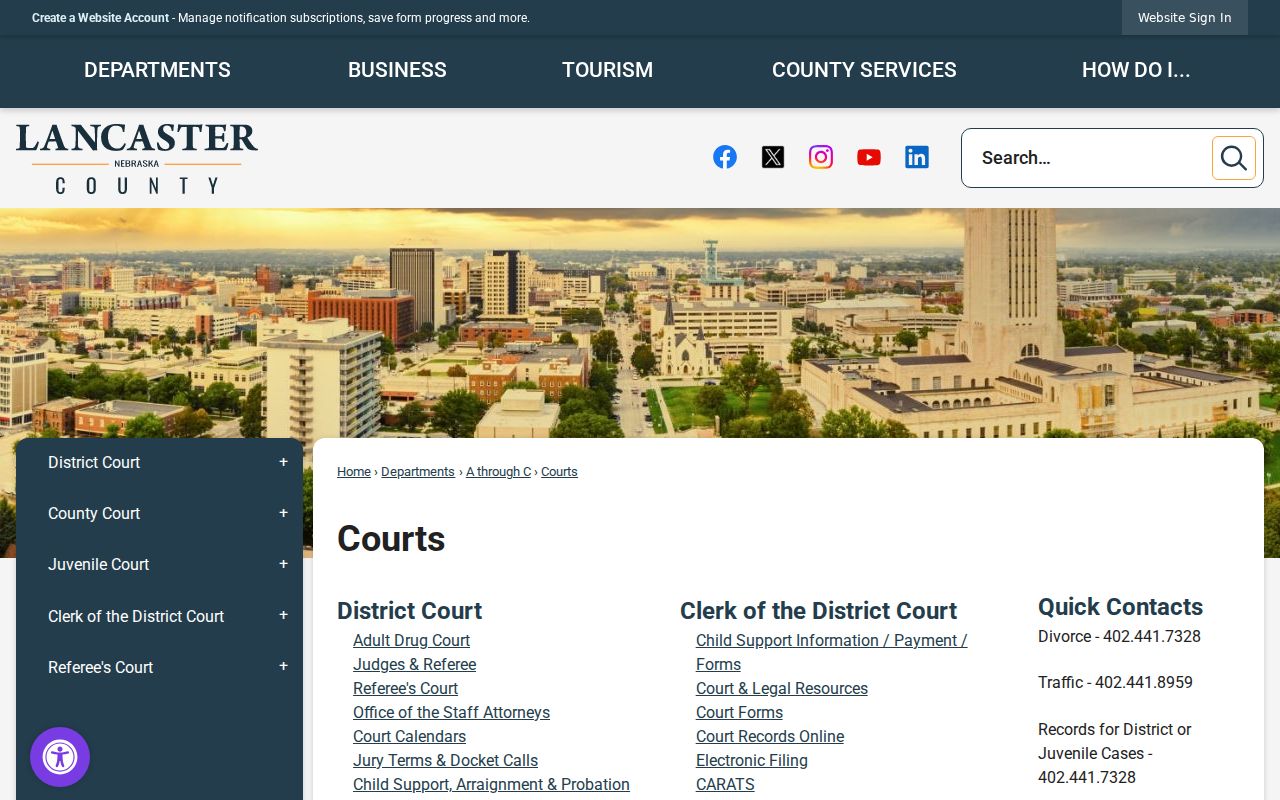
Local routes work alongside the statewide search. Use them to confirm a setting, find a clerk division, or request a specific Lancaster record.
What a Court Docket Shows
Read a Lancaster case result in layers. The summary gives identification and status at a glance. The Register of Actions is the dated list of events and documents. It can include filings, summons or returns, motions, notices, hearings, orders, judgments, costs, payments, satisfaction activity, and appeal entries. A public document link, where one exists, is not the same thing as the index entry. That index entry is what names it.
| Case number | The court's identifier. Copy it exactly rather than trying to infer a prefix or sequence. |
|---|---|
| Parties and caption | The names connected to the matter and the case style, which may use a government designation in a criminal case. |
| Register of Actions | The chronological record of case events, filings, settings, orders, costs, and related activity. |
| Hearing setting | A scheduled date, time, courtroom, judge, and setting type when entered by the court. |
| Court and judge | The division that holds the record and the assigned judicial officer shown in the case information. |
| Status or disposition | A recorded outcome or case status. Read the actual order when the legal effect matters. |
Filed does not mean ruled on. A motion shows activity; an order shows the court acting. A payment entry, in the same way, records money moving but does not settle every question about the obligation.
Lancaster Docket Terms Explained
Lancaster court terms are not interchangeable. Treating them alike sends searchers to the wrong source. The permanent general index and the Register of Actions may live in JUSTICE, microfilm, or archives. Calendars and docket calls, by contrast, handle scheduling.
- Case summary
- The high-level result showing core case identification and status information.
- Register of Actions
- The dated, chronological list of events and filed documents in the case.
- Docket call
- A group scheduling or readiness call, not the case's full event record.
- Court calendar
- A list of scheduled settings, which can change after a reset or continuance.
- Certified copy
- A clerk-authenticated copy of a specified record, not simply a printout from a search result.
Need a recent setting? Compare the calendar against the latest Register entry. If the two disagree, confirm with the clerk.
Which Courts Keep Dockets
Jurisdiction splits Lancaster's trial-court records. The Third Judicial District Court is the general-jurisdiction court. It handles felonies past the preliminary stage, domestic relations, paternity, equity, and civil matters above the County Court limit. Lancaster County Court holds the rest. Its docket covers county civil matters concurrent up to $70,000, small claims, probate, guardianship, conservatorship, adoption, misdemeanors, traffic cases, felony preliminary hearings, and municipal ordinance matters. Juvenile cases follow a separate court with its own record path.
| Court | Docket covers | Where to start |
|---|---|---|
| District Court | Felonies after preliminary hearing, domestic relations, paternity, equity, and civil matters beyond $70,000 | JUSTICE, local district calendars, or the District Clerk |
| County Court | Civil matters to $70,000, small claims, probate, adoption, misdemeanors, traffic, ordinances, and felony preliminaries | JUSTICE, County Court, or the County Court calendar |
| Separate Juvenile Court | Juvenile delinquency, dependency or neglect, and specified matters involving minors | Juvenile Court administrator and the applicable access rules |
Lancaster District Court describes the Third Judicial District's local court role.
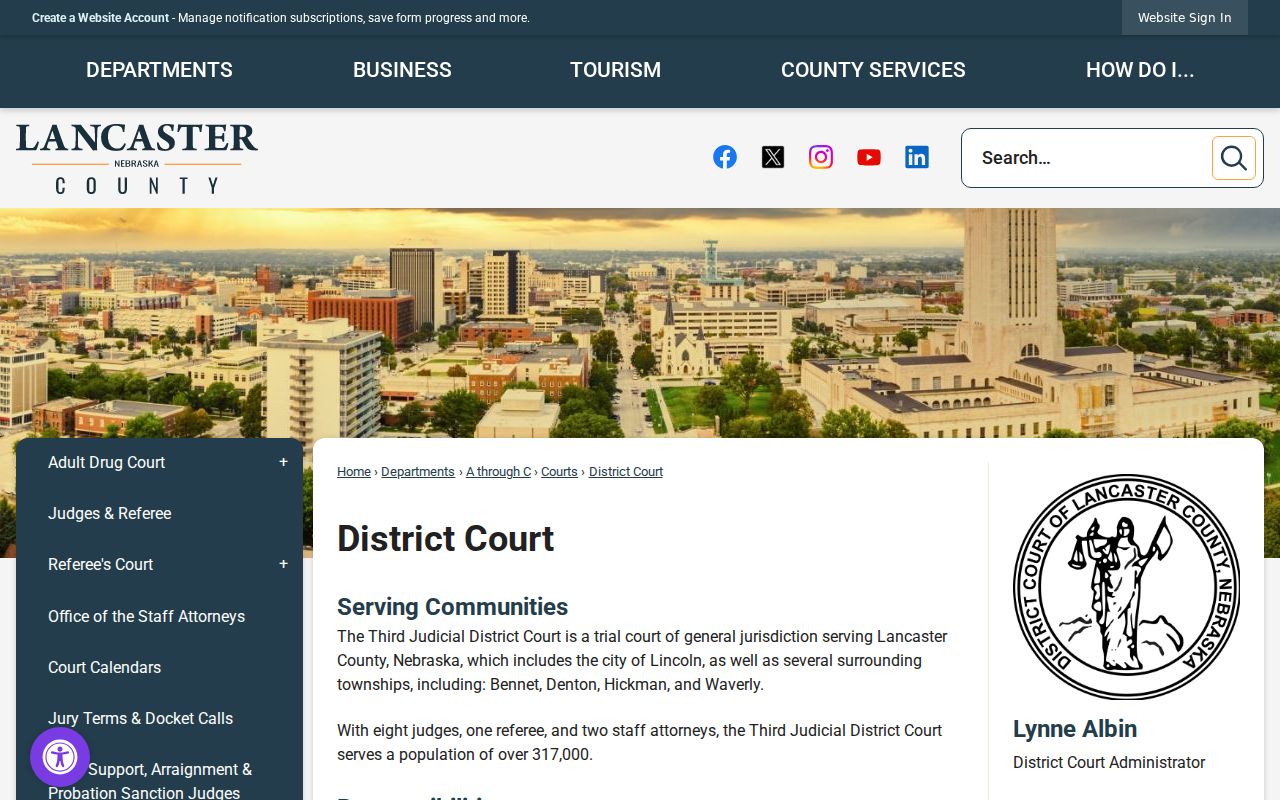
District docket questions usually need the case number, year, and the exact document or setting at issue.
Lancaster County Court's official page lists the divisions covering its broader mix of local case types.
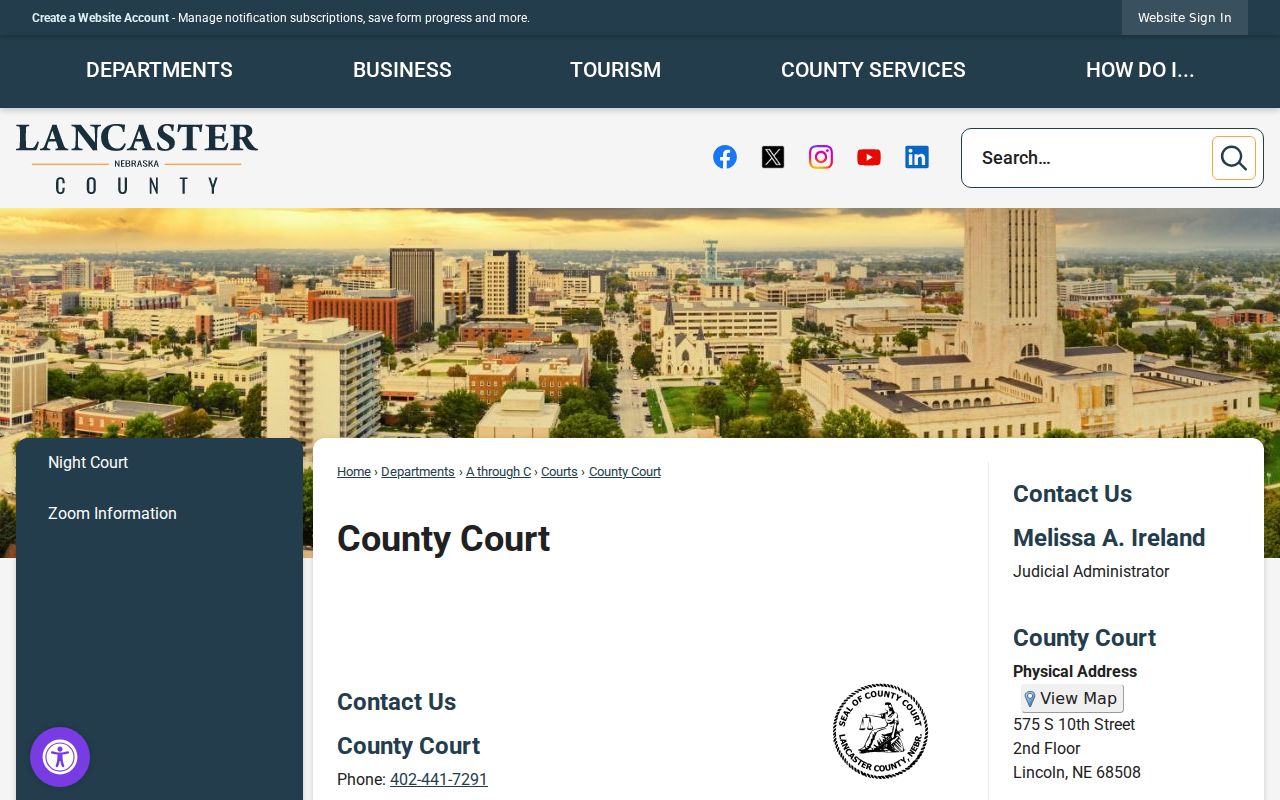
City ordinance complaints can also route here under Nebraska law. So a city name on a citation does not guarantee a separate city docket.
Lancaster Separate Juvenile Court
Lancaster is unusual. Juvenile matters sit in a separate Juvenile Court, not an ordinary County Court division. It is a court of record. Its reach covers delinquency, dependency and neglect, and certain domestic-relations matters involving minors. That structure changes the first call and what the public can access. An adult County or District Court search will not substitute for the juvenile route.
Lancaster Juvenile Court sits on the fourth floor of the same Justice and Law Enforcement Center. It has its own administrator and court contact. Juvenile records can be sealed under Nebraska law. An adjudication is not an adult criminal conviction. Ask the court what version may be inspected. Do not reconstruct a restricted matter from a name search.
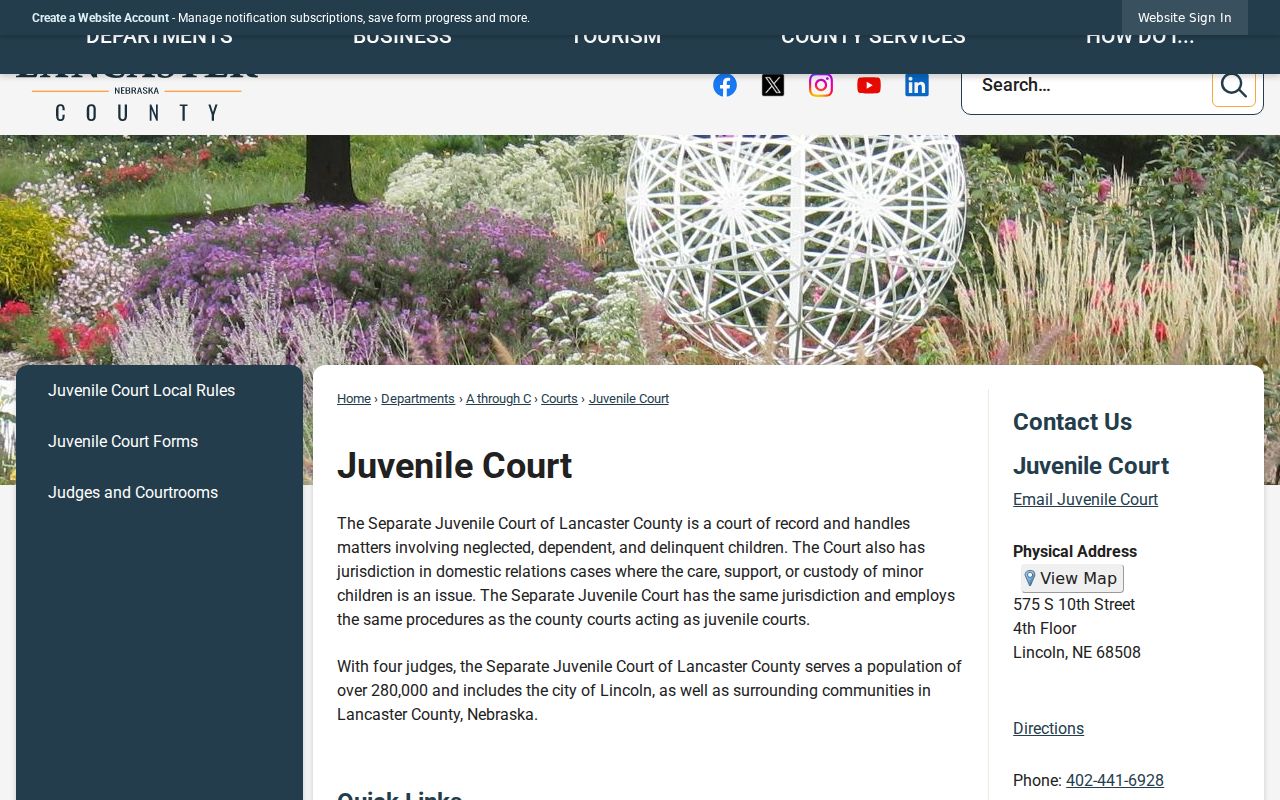
The separate court is a routing matter in practice. When a case description involves a minor or a juvenile proceeding, start there.
A 46,355-Case Lancaster County Court Year
Lancaster County carried a heavy docket in FY2025. The Nebraska County Court Caseload Report lists 46,355 adult County Court cases for the year. Civil matters formed the largest named group. Traffic and misdemeanor cases came next. The figure leaves out Separate Juvenile Court activity, so it is neither an all-court count nor a forecast for any single case.
The caseload matches the jurisdiction table. A traffic case, a small civil claim, and a felony preliminary matter can all begin in County Court, yet each calls for different filters and follow-up steps.
Finding Court Dates and Settings
Two tools answer different questions. A calendar lists settings. The Register of Actions keeps a case's event history. Nebraska's multi-court calendar lets you search by current or future date, or by a last name of at least two characters. Results identify the court, courtroom, judge, date, time, case number, caption, and setting. Treat any listed date as provisional. A setting can be reset, continued, or changed by an order, so the newest Register entry and a clerk's confirmation still matter.
The Nebraska multi-court calendar works well for County Court settings. For a fuller walkthrough of date sources, plus what follows a missed setting, see the Lancaster County court calendar. The county also posts judge-specific PDF calendars. Docket-call notices add room and term context that a statewide lookup lacks.
Night Court is a scheduling option. It is not a separate docket. In 2026, selected noncustody matters are set on March 19, June 18, September 17, and December 17, from 4:00 to 5:30 p.m. in County Court room 24. A posted Zoom room ID does not grant automatic permission to appear remotely. The case's current instruction, courtroom, and clerk control.
Lancaster District Calendar Gap
The statewide calendar carries its own caution. Its data may not reflect every setting. An empty result does not prove a hearing was cancelled. For Lancaster District Court the warning bites hard. The District Court calendar is not fully displayed there. So a blank district search should point you toward the local calendar and the clerk. Do not assume a cancellation.
Lancaster's Court Calendars page offers judge- and room-specific PDF calendars. A separate Jury Terms and Docket Calls publication adds term and scheduling context. Call the District Clerk's office at 402-441-7328 if the assigned judge or a recent change is unclear. A clerk can confirm the public setting route. What a clerk cannot do is give legal advice about what a setting means.
When a judge or courtroom is unclear, a directory helps. The Lancaster's Judges and Referee directory identifies the current courtroom and judicial-officer assignments. It covers courtrooms across the county.
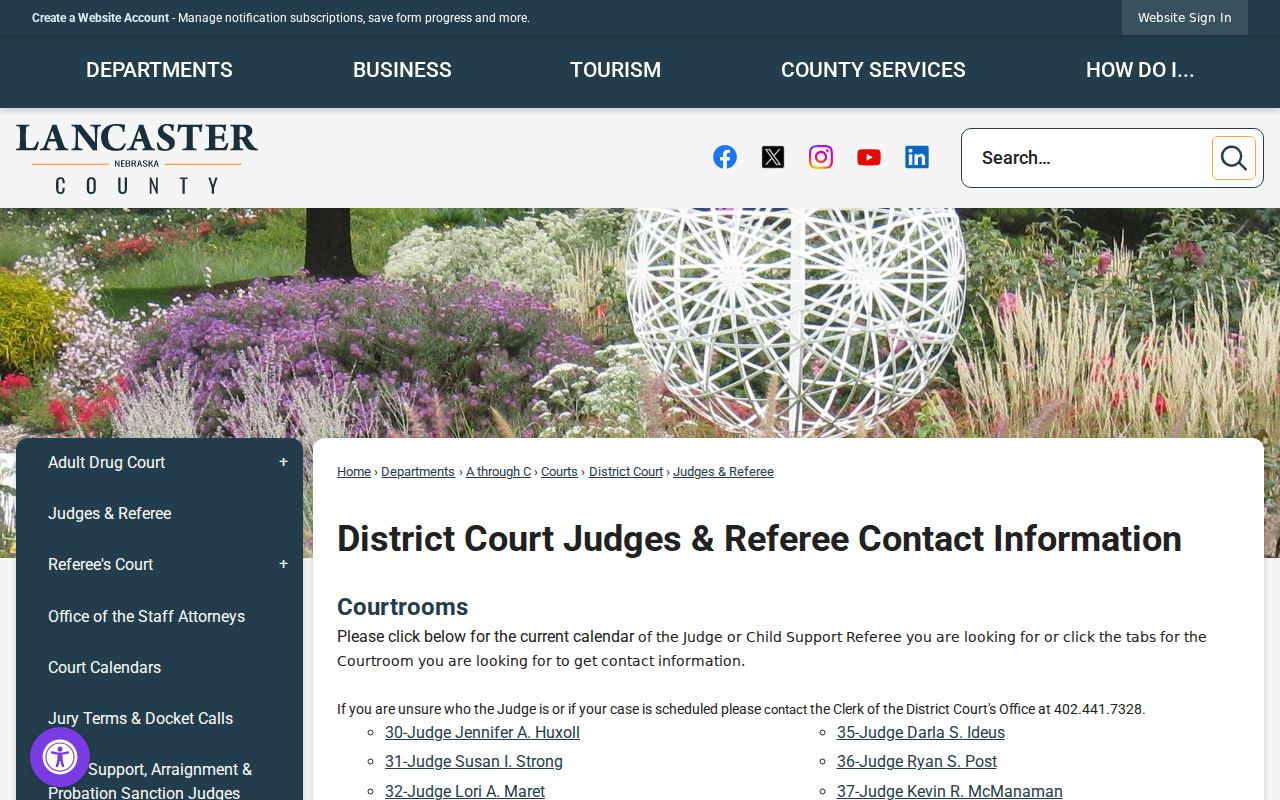
A judge or courtroom listing has one clear use. It connects a PDF calendar entry to the court named on a case record, so the docket detail lands in the right place.
Public Access to Dockets
Nebraska opens much of its court record system to the public. Electronic access covers party indexes, summary information, Registers of Actions, calendars, and certain judgments, orders, decrees, and images. Access has limits. Exceptions and court orders apply. So does system maintenance. A record may be open for inspection at a clerk's public terminal. Its image may not be available for remote copying. Public access does not override a seal, a redaction rule, or a protected juvenile record.
Key public-access rules
Article 8, §§ 1-801 to 1-810 identifies public electronic fields, including party indexes, summary information, Registers of Actions, calendars, and available images, subject to exceptions.
Nebraska Court Rule § 2-215 allows public inspection of electronic records at a clerk public terminal or designated location unless law, rule, or order restricts the filing.
Nebraska Public Records Act § 84-712 governs inspection and copies, with a general four-business-day framework for an estimate, access, denial, or explanation.
Rule § 6-1466 protects criminal personal and financial information through redaction, restriction, or sealing procedures.
Juvenile records sit under separate rules. Nebraska's juvenile statutes control access, so the Lancaster Separate Juvenile Court is not just another tab in an adult case search.
Lancaster Records From Microfilm to Public Images
A missing image proves nothing. It does not show that a case is sealed or that no record exists. The cause could be a very recent case, a name-search mismatch, or the 30-result cap. It could also be a restricted document, retention treatment, or an older record still in paper, microfilm, or an archive. The Register of Actions has a permanent-record role. But a permanent index is not the same as a clickable image for every historical filing.
For an old case, gather details first. Give the court, full party name, approximate year, case type, and any known case number, then ask for a specific public order, pleading, or register entry. That narrow request gives the clerk something workable, and it keeps a broad search result from standing in for a complete historical file.
History Nebraska's historic Lancaster County courthouse postcard dates from roughly 1907 to 1917. That courthouse is local history now. It is not the current court building. It is not a current records location.
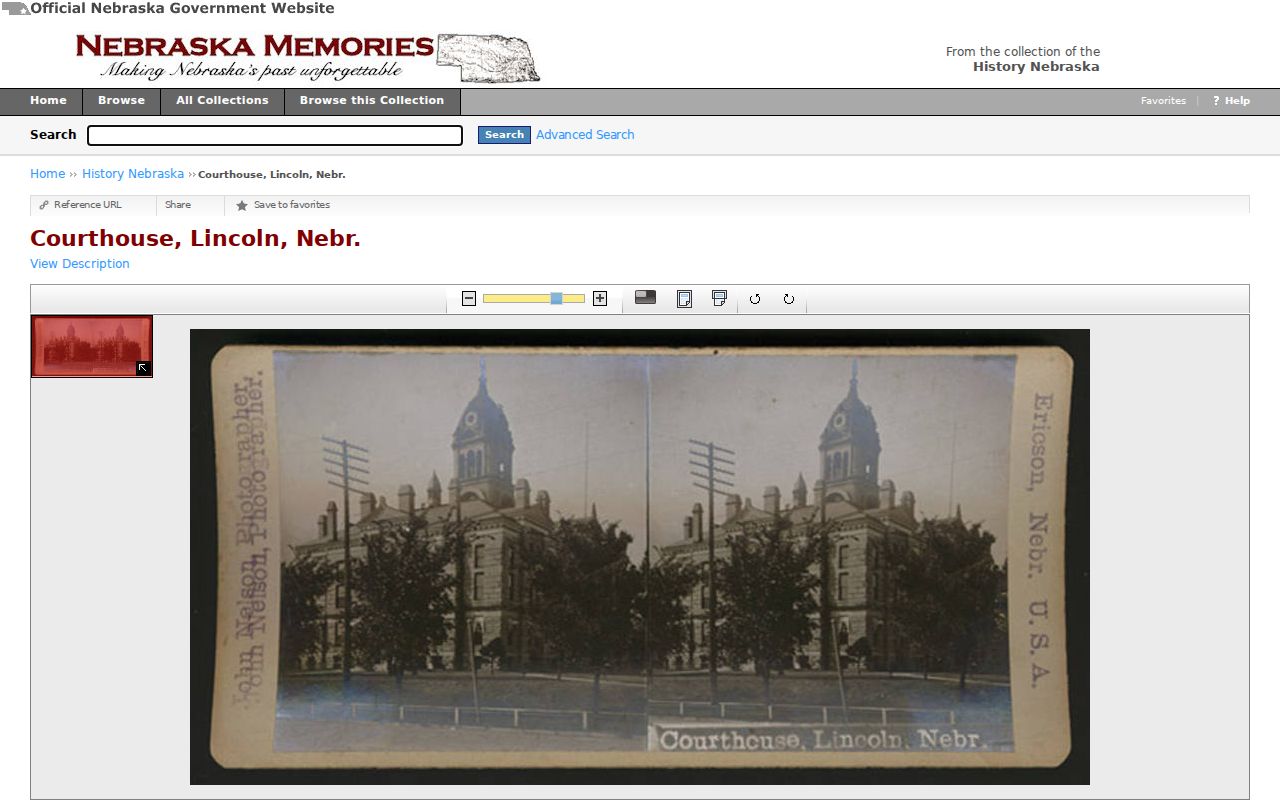
Lancaster's current trial-court records take a different route. They run through the Justice and Law Enforcement Center and the relevant clerk office, not this historic courthouse.
The Clerk and Docket Records
Lancaster County splits its clerk duties between two offices. The Clerk of the District Court keeps the District Court docket records. A separate County Court office handles other files. Melissa Ireland runs it. Her office holds county civil, small claims, criminal and traffic, probate, and adoption files. Pick the right office before you ask for copies.
When you request a court record, be specific. Give the case number and year, the parties, the case type, and the order or pleading you need. A precise request gets answered faster. Clerks manage records, though, and cannot give legal advice. Also note that Nebraska court policy will not certify that a record does not exist.
The District Clerk's local request form covers Civil, Criminal, and Juvenile cases. It lets you choose email or paper delivery, and certified or noncertified copies. Paper runs $.25 per page plus postage. A certified email packet starts at $1.00. That packet arrives as one merged PDF. It includes an index, bookmarks, the clerk's signature and seal, and page certification marks. For County Court files, skip the District form. Go to the proper County Court division instead.
District Court Clerk, Simon Rezac
Justice and Law Enforcement Center, third floor
575 S 10th St.
Lincoln, NE 68508
402-441-7328
Lancaster District Court records desk
County Court answers its general line at 402-441-7291. Civil and small claims uses 402-441-7271, criminal and traffic 402-441-8959, and probate and adoption 402-441-7443.
Lancaster Clerk Records Requests
When no public image exists or you need certification, turn to the District Court Clerk records request form for a district record. The form asks for the document, order, or pleading. It also wants a case number, year, party names, and case type when you know them. Email or paper, certified or noncertified, you choose. The stated response window is within two business days, though the real time to locate, copy, certify, and deliver a docket record varies with the request.
Precision beats asking for an entire file. Want to confirm a ruling? Name the order and its rough date. Tracking a case event? Start with the Register of Actions and copy the entry word for word. For a fuller look at the documents behind the docket, the Lancaster County court records page sorts out ordinary copies, certified records, and transcripts.
Court Dockets by City in Lancaster County
Lincoln, Waverly, Hickman, Bennet, and Firth are the county's five largest incorporated places in the 2020 Census table. All five fall under the same Lancaster County trial-court structure. None of these cities runs its own municipal-court docket portal. A city ordinance complaint lands in County Court under Nebraska § 25-2703. A city administrative notice may move through a separate city process. Check the court or case number on the notice. Then pick a search route.
Lincoln Court Docket
291,082 residents in 2020 · City-code complaints can route to County Court; parking citations may be administrative.
Waverly Court Docket
4,279 residents in 2020 · Search a state-court case through Lancaster County rather than a Waverly-only docket.
Hickman Court Docket
2,607 residents in 2020 · City code access and court records use different official routes.
Bennet Court Docket
1,082 residents in 2020 · A village label does not create a separate county trial court.
Firth Court Docket
649 residents in 2020 · Citation instructions and case type determine the local record route.
Map and Directions to the Lancaster County Justice and Law Enforcement Center
District Court files are kept on the third floor of the Justice and Law Enforcement Center, 575 South 10th Street in downtown Lincoln, where the Clerk of the District Court's office sits. County Court occupies the second floor and the separate Juvenile Court the fourth floor of the same building, so identifying the case type before arrival determines which floor to visit. The federal courthouse, the Robert V. Denney Federal Building at 100 Centennial Mall North, is a different building entirely.
District Court Clerk, Simon Rezac
Justice and Law Enforcement Center, third floor
575 S 10th St.
Lincoln, NE 68508
402-441-7328
Monday through Friday, 8:00 a.m. to 4:30 p.m.
Courts are open 8:00 a.m. to 4:30 p.m. except legal holidays. Lancaster's jury information identifies the Carriage Park Garage near 11th and L as a downtown parking option with a trolley connection to the courthouse area. Confirm any special closure before travelling, since the courthouse is separate from both the County/City Building at 555 S 10th and the federal building on Centennial Mall.