
The Lancaster County Court Calendar
Lancaster does not run on a single calendar. Several official layers exist. The Lancaster Court Calendars page posts District Court calendars judge by judge and courtroom by courtroom. For term dates, docket calls, and other recurring settings, the Jury Terms and Docket Calls page adds another layer. County Court settings can be checked through the statewide calendar as well, and through the case's Register of Actions, which lists filed events and settings in order.
Know which court you are in first. Lancaster County Court takes misdemeanors, traffic, small claims, probate, adoption, and felony preliminary hearings. The Third Judicial District Court handles felonies past that stage, plus domestic relations, paternity, equity, and larger civil matters. A separate Juvenile Court sits in Lancaster too. Never assume a setting listed for one court governs another court's calendar.
Lancaster PDF Calendars by Judge
The local calendar index pays off when you already know the District Court judge. It helps with the room too. It points to judge-specific PDFs covering rooms 30 through 37 plus the referee in room 38. Current contacts list Judges Jennifer A. Huxoll, Susan I. Strong, Lori A. Maret, Matthew O. Mellor, Andrew R. Jacobsen, Darla S. Ideus, Ryan S. Post, Kevin R. McManaman, and Referee Jennifer Kulwicki. No judge in mind? The District Court clerk will confirm the right calendar at 402-441-7328.
The county's Court Calendars index is where this Lancaster court calendar image comes from.
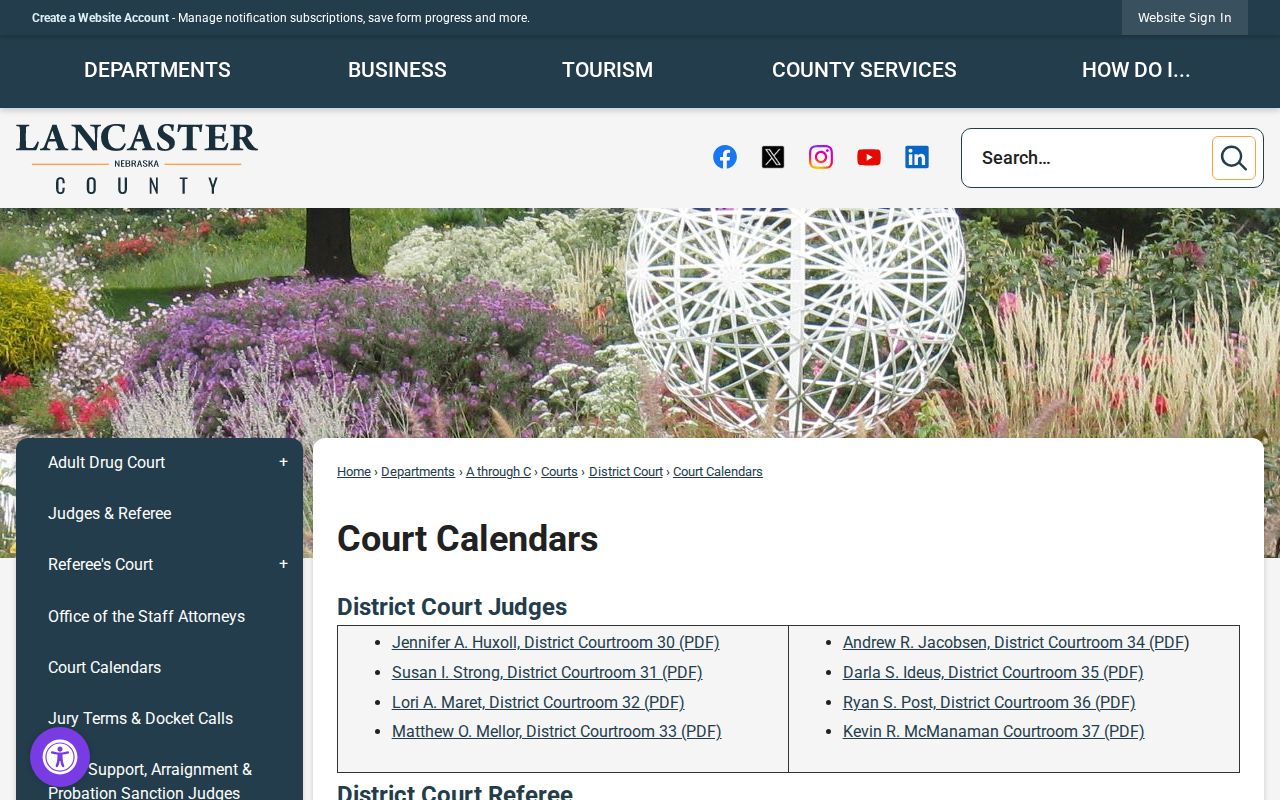
A PDF calendar works well for room-based schedules. It is no promise a given case will actually move at that hour. Check the case record or the clerk for any recent change.
How to Find Your Court Date
Match the route to the question. With a known case, go straight to JUSTICE and its Register of Actions. For a date-only or last-name search, the state calendar is the natural starting point. District Court users should also pull the local PDF calendar. The reason is that the statewide display does not yet carry every Lancaster District Court setting. When a date is close or the record looks murky, the clerk counter is still the practical way to confirm. So is the phone line.
- Open the JUSTICE one-time search or the case information service, locate the case, and read its most recent Register of Actions entry for a setting, continuance, or order.
- Use the Nebraska multi-court calendar to search a current or future date or a last name. Select the relevant court and Lancaster County.
- For District Court, open the local judge-and-room PDF calendar. For jury terms, docket calls, arraignment, child-support, or probation settings, use the county’s local PDF and daily calendar or docket-call route.
- Confirm with the clerk by phone or at the clerk counter. District Court questions go to 402-441-7328. County Court’s general line is 402-441-7291, and the party’s attorney can confirm the current case setting.
Local postings and a docket call can locate a group setting. Still, the current case record controls any case-specific question. Give the clerk the case number, full party name, court, and the date being checked.
Six Lancaster Jury-Term Windows
The published 2026 jury terms are January 5 to 16, March 2 to 13, May 4 to 15, July 6 to 17, September 8 to 18, and November 2 to 13. Those are planning windows, nothing more. They do not set a hearing date for every case inside them. The local calendar also groups docket calls on Wednesdays or Thursdays in 1:30, 2:30, and 3:30 p.m. blocks, varying by term and judge.
Lancaster's Jury Terms and Docket Calls page publishes the term material behind this Lancaster court calendar image.
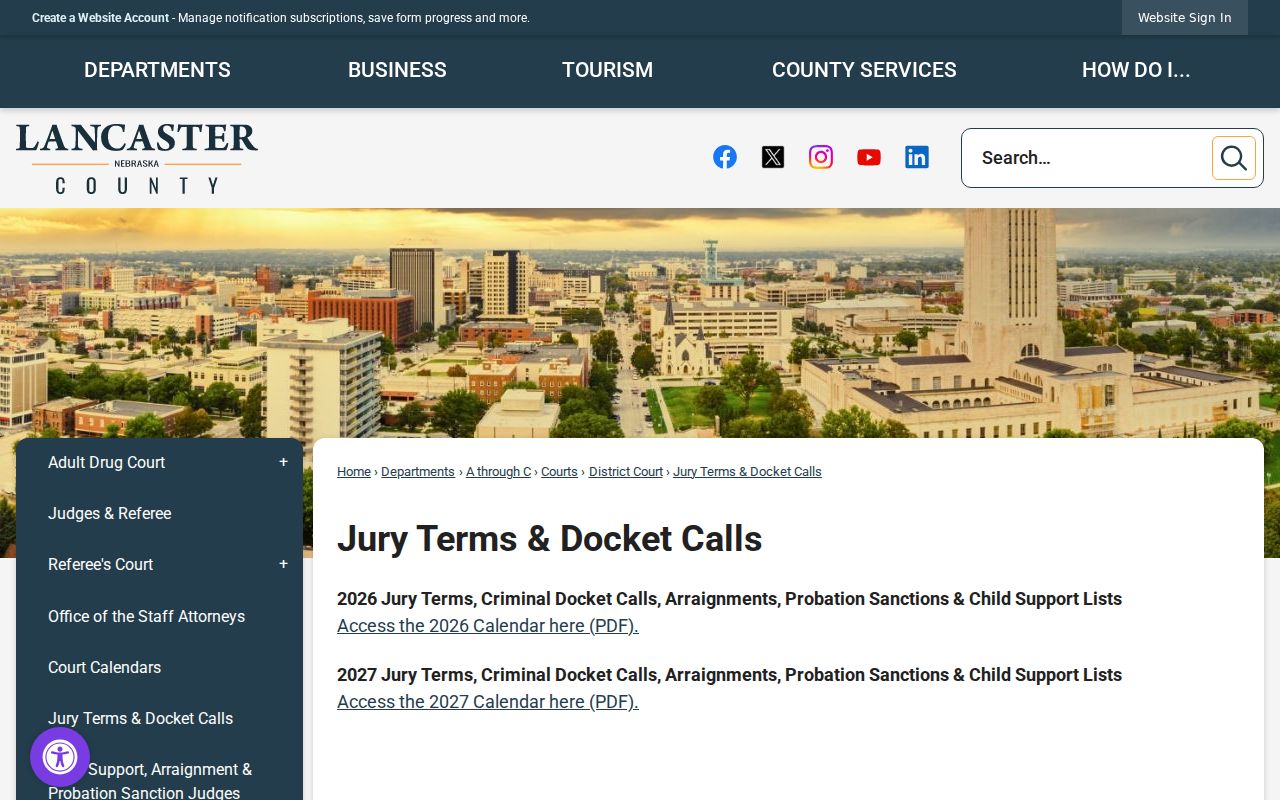
Monthly arraignment, child-support, and probation-sanctions settings may appear there as well. Treat each PDF as a dated planning record. A later Register of Actions entry or a call to the clerk can pull an individual case out of its original calendar block.
Reading a Court Setting
A setting is a scheduled appearance. It is not necessarily a trial. Read every field together, since context changes meaning. A docket call can lump several cases into one time block for scheduling or readiness, while an individual hearing serves one specific purpose. The case summary names the case at a high level. Only the Register of Actions shows the running sequence of events that tells you whether a listed setting still holds.
| Date | The court day shown for the event. Confirm a recent reset before relying on it. |
|---|---|
| Time | The listed start time or a docket-call block, which may be shared by several cases. |
| Courtroom | The assigned room or court location. District Court calendars use rooms 30 through 38; County Court uses its own rooms. |
| Judge | The presiding judge or referee named for the setting. A coverage question can be directed to County Court’s general line. |
| Setting Type | The event purpose, such as arraignment, pretrial hearing, docket call, trial, or a scheduled review. |
Never read "filed" as "decided." A motion entry records activity, while an order records a ruling. The same distinction matters when a setting sits next to a new motion or notice.
Lancaster Docket Calls and Terms
A docket call is a scheduled call of a group of cases for scheduling, readiness, or related action. It is not the case's full Register of Actions. A court calendar lists settings. A jury term is wider, a stretch of weeks in which jury matters get planned. Lancaster materials often show these side by side. They answer different questions.
- Setting
- A date and time assigned to a case event.
- Docket call
- A grouped calendar call, often in a published time block.
- Register of Actions
- The case’s chronological event list, including later resets or orders when public.
When a term calendar and a current setting seem to conflict, trust the case-specific Register of Actions and the clerk's current information. That sequence keeps a general term date from being mistaken for a personal appearance notice.
Resets, Continuances, and Cancellations
A reset or continuance means the setting moved. It does not dismiss the case. It also decides nothing about a pending motion. Where does the new date show up? Sometimes the Register of Actions, sometimes a fresh local calendar PDF, and sometimes the clerk's current calendar. The statewide calendar itself warns that its data may lag behind recent changes, so treat a missing or shifted entry as a prompt to confirm, not a conclusion.
Put the calendar date next to the newest Register of Actions entry. Then, if an appearance is coming up soon, call the clerk or your attorney. Settings can vanish from one view after a courtroom change, a case split, a continuance, or a cancellation, and only the court or clerk holding the live record can say whether you still need to appear.
Note: Have the case number and full name ready when confirming a reset, since similar captions can sit on the same docket call.
Lancaster Zoom Is Not Permission
Lancaster posts Zoom information for County Court rooms 20 through 26, each listing kept separate. That meeting link is only a route into the courtroom. It is not permission to appear remotely. The county says outright that defendants assigned to courtroom 23 need approval first. Attorneys may handle non-evidentiary matters over Zoom under the local instructions, but the case setting and the court's direction always control who shows up and how. Lancaster County's Zoom information page is the official page this Lancaster court calendar image draws from.
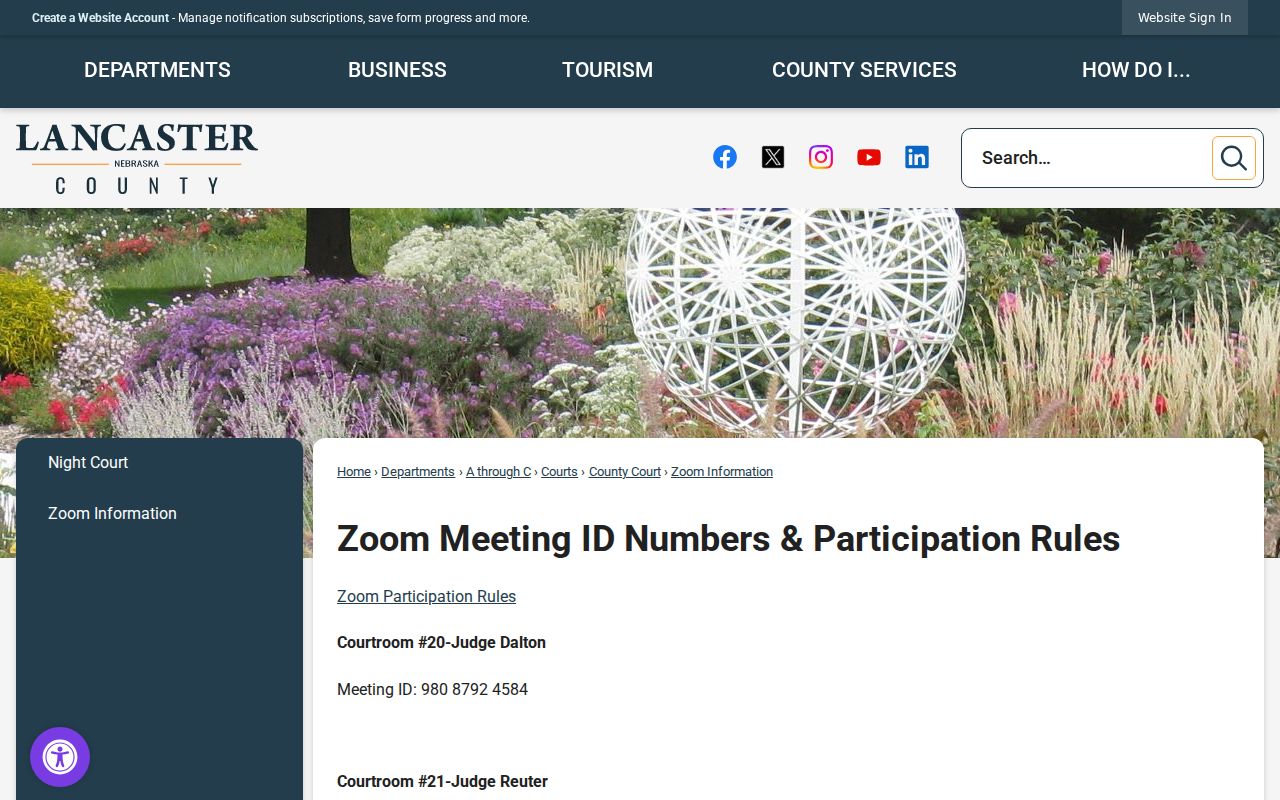
Join with your full name and case number if the court authorizes remote participation. If another judge may cover the session, call the County Court general line at 402-441-7291 first. Never treat a room's meeting ID by itself as an instruction to appear.
What To Do If You Miss a Setting
Act quickly after missing a Lancaster setting. Start with the Register of Actions. Look for any new entry there. Then call the clerk for the court holding the case. Reach out to counsel if you have one. The clerk can point to the current public setting record. The clerk cannot offer legal advice, though, or promise a new date was granted. Consequences in a criminal, traffic, or other case hinge on its order and the reason for the absence.
Missed a Setting? Missing a court date may result in a failure-to-appear entry, a warrant, bond consequences, or another court order.
Call the appropriate clerk or attorney immediately with the case number and ask what public setting information is current.
Seek advice from a licensed attorney before appearing on a missed Lancaster County court setting.
Lancaster State Calendar Gap
The state calendar offers County Court and District Court selectors plus date and last-name searches. Its own notice warns that a blank result does not necessarily mean no setting exists. Here is the gap. Lancaster District Court calendars are not fully included in that statewide display. A blank district result is a cue to check the local PDF calendar and call the clerk. It is not proof a hearing was cancelled. The Nebraska multi-court calendar is the official statewide search interface. It is shown in this Lancaster court calendar image.
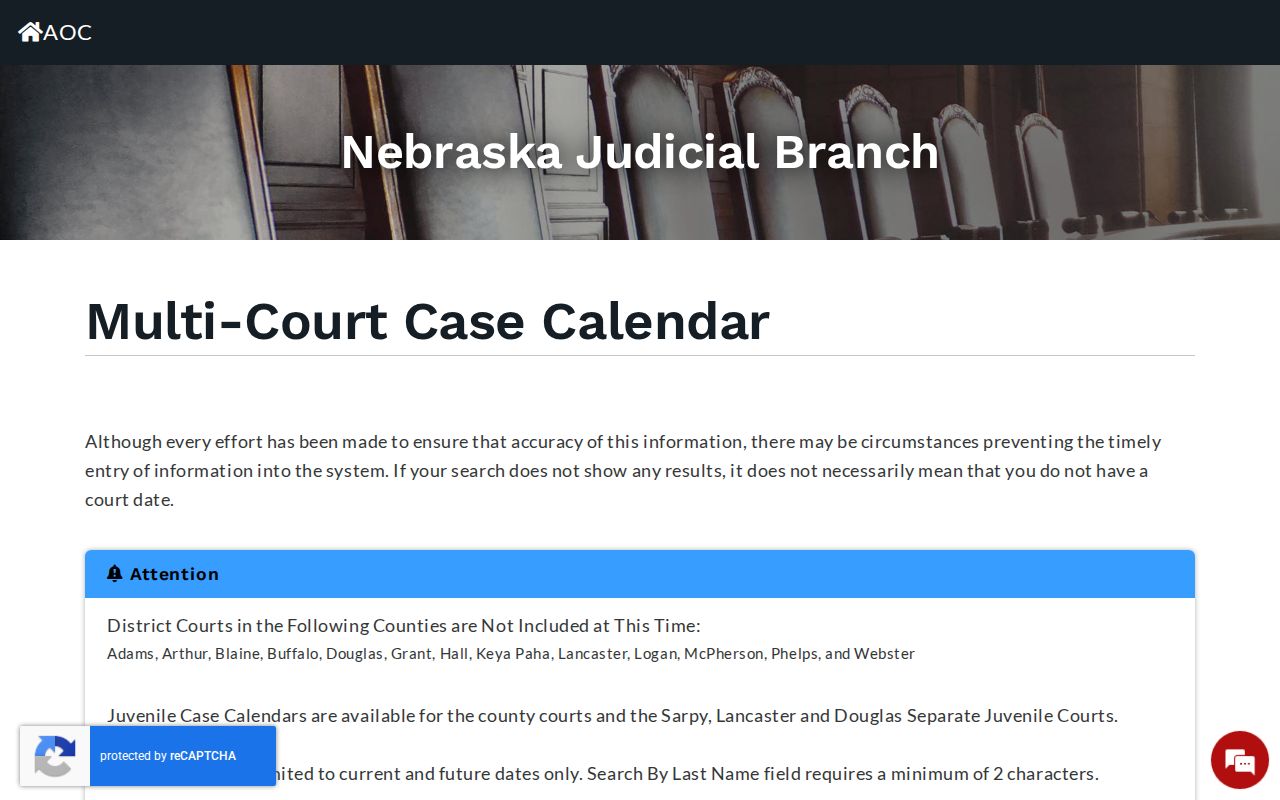
Search with a last name of at least two characters. You can also use a current or future date. Then confirm any critical District Court setting through the local source. The calendar is a valuable check. It does not replace the active court file.
A statewide search works well as a first check on a County Court setting. For a Lancaster District Court setting, pair it with the room-specific PDF. Then call the clerk. That two-source habit matters most after a continuance. It also matters when a docket-call calendar gives only a time block. Write down the date, time, court, judge, and case number from the result. The clerk can then fix a discrepancy without digging through a broad calendar.