
How to Get Court Records
Work from the court, not the county line. The Lancaster District Clerk keeps Third Judicial District records. Those cover civil, felony, domestic-relations, paternity, equity, and appellate cases. Lancaster County Court keeps its own files. They include civil, small claims, probate, adoption, misdemeanor, traffic, and preliminary-hearing matters. Juvenile Court runs separately, with its own administrator and its own record rules. A public case search can hand you the case number and any available images. For an actual copy or certification, though, turn to the right clerk. A records request is the route.
- Find the court, exact case number, case year, involved party names, and the precise order, pleading, or other record sought. Start with JUSTICE when a public statewide case search can identify the file.
- Use the clerk counter or public terminal for in-person inspection where public access permits. Call District Court at 402-441-7328, press 5 for records questions, or call the County Court division that holds the County Court file.
- Submit the District Court records request form online for a district record. Requesters who need paper delivery may use the clerk’s paper or mail route after confirming instructions; give phone and email contact details.
- Choose email or paper delivery and choose a plain or certified copy. Pay the quoted amount before the clerk processes the request, then keep the case number with the response.
- For a public-record request outside the ordinary court-copy route, use the applicable clerk or county records channel and the Nebraska Public Records Act framework. It does not override court restrictions or seals.
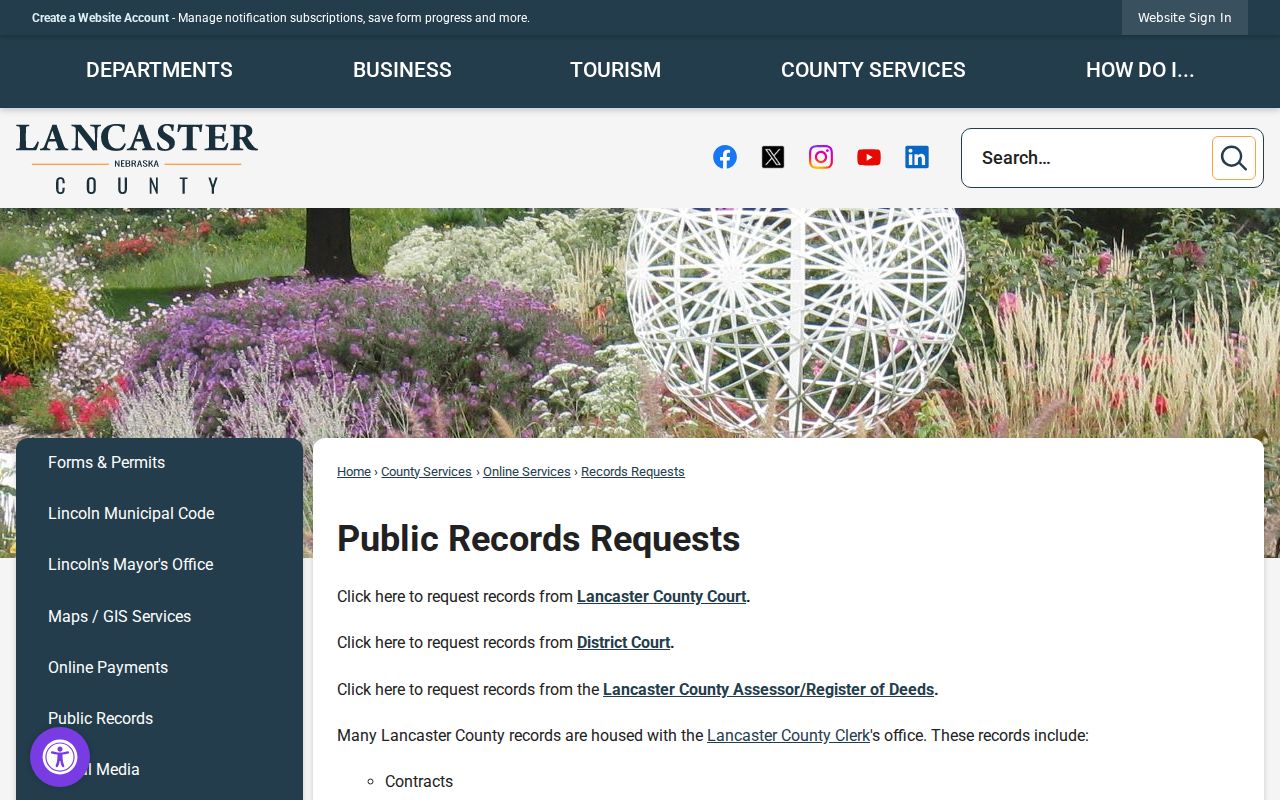
The county's Lancaster County records request hub routes general county requests. Court records are different. Those still go to the court or clerk that maintains them.
Lancaster Court Records Form Details
The District Court form wants specifics. Expect to give your name, phone, email, a description of the document, order, or pleading, the case type, your government-agency status if any, how you want delivery, and whether you need certification. Some fields are optional. These include case number, year, plaintiff or petitioner, defendant or respondent, and date of birth. They help, though. Use "other details" to pinpoint a filing date or the exact document sought, not to request an entire private file wholesale. The Lancaster County records-request page posts the official form details for Lancaster court records.
After payment, the District Clerk processes the form. County Court copies take a different path. Send those to the County Court office instead. What matters is which court holds the record, not where a party happens to live.
Types of Court Records
Think of a docket as an index with an event history attached. The court record is the stack of documents behind that index. Access varies. It depends on the case, the document, the court, and the method you use. Be careful what you rely on. A docket entry noting a signed judgment is not the same as the judgment itself. A transcript sits apart too. A court reporter prepares it through a separate request process.
- Complaint or petition, summons, and return of service.
- Answers, motions, briefs, notices, and filed exhibits when public.
- Orders, decrees, judgments, and later satisfaction or appeal records.
- Register of Actions entries, costs, and payment records.
- Typed transcripts and appeal material, which may require a distinct request.
Public images in JUSTICE can help you spot an item, especially nonconfidential filings made after April 16, 2008. They are not proof that every historical paper document is online. Some older files simply never got scanned.
Specific Lancaster Court Record Requests
Ask small. "Signed judgment entered on a known date," "order on a named motion," or "complaint in the identified case" gives the clerk a real target. Nebraska's court records search policy lets a clerk search specified records. You must supply a complete party name, the case year, and the case type. It does not force the court to assemble a broad research file for you. One more limit applies. The court will not certify that no record exists. A search that comes up empty might mean many things. It could be a name error, a recent filing, an indexing issue, retention rules, a different court, or an access restriction. For an old District Court matter, hand the clerk the case details. Ask whether it sits in JUSTICE, microfilm, or archives.
What a Court Record Contains
Read a court file in layers. The case summary gives identifiers and status. The Register of Actions lays out the dated sequence of events. The pleadings and orders hold the actual legal text. This layering matters, because a motion marked "filed" only proves it was submitted; a later order tells you how the court ruled. In the same way, a payment entry can show activity without proving every obligation was satisfied. Always check the layer that answers your question.
| Case Number | The exact court identifier used to locate the file and to request a particular document. |
|---|---|
| Pleadings | Documents such as complaints, petitions, answers, motions, and briefs that frame the issues. |
| Orders & Judgments | Signed court rulings, decrees, judgments, and other decisions that determine a matter. |
| Register of Actions | The chronological case-event list, including filings, notices, settings, and later entries. |
| Exhibits | Filed attachments or evidence when they are public and releasable under the governing rules. |
When the stakes are real, get the signed order or a certified copy from the clerk. A public search display is not a substitute for the document itself.
Lancaster Court Records and Images
District Court Schedule 8 treats the general index and Register of Actions as permanent records. They are held in JUSTICE, microfilm, or archives. Permanent indexing does not put every old image online. Lancaster's District Clerk materials describe a long-running project to digitize and preserve more than a century of microfilm. So an older file may still need clerk or archive research. The case stays indexed the whole time. Retention rules also differ by court and case type. County Court guidance permits destruction of some traffic offense records five years after satisfaction or dismissal. So a missing old image calls for a specific question to the clerk. Don't assume the case never existed or was sealed. The Nebraska retention schedules show why age and record type drive these outcomes.
Certified Copies and Fees
Know your two options. A plain copy just reproduces the public document. A certified copy carries the clerk's authentication, which another court or agency may demand before accepting it as an official court record. The District Court form offers both. Its certified-email route assembles a merged PDF with an index and bookmarks. That index carries the certification text plus the clerk's signature and seal, and each page reads "Certified Page # of #."
| Item | Amount |
|---|---|
| Paper copy | $0.25 per page, plus possible postage. |
| Certified email packet | Begins at $1.00; the final charge depends on the request. |
| Certification or archival service | Ask the clerk for the current quote when the form does not state the total. |
| District Court records questions | 402-441-7328, press 5. |
Clerk of the District Court
575 S. 10th Street, Third Floor
Lincoln, NE 68508
402-441-7328
The fee table covers copying and certification only. It does not include a paid JUSTICE name search, a filing fee, or a court reporter's transcript cost.
Lancaster Court Record Transcript Fees
A typed transcript is its own product. It is distinct from a docket printout or a standard copy from the case file. Parties and their counsel have a direct route. They can order a full or partial District Court transcript straight from the official court reporter. Anyone else needs the trial judge to sign off first. The reporter quotes an estimate. Payment comes before any work starts. The District Court transcript instructions walk through that separate process.
The fee schedule effective January 1, 2024 sets the page rates. An original transcript page runs $3.90. A copy page costs $0.90. Expedited service adds more, with rates of $5.00 per page for seven-day, $5.60 for three-day, $6.20 for daily, and $7.40 for hourly. Realtime rates are listed separately. Scanning or producing a documentary exhibit is $0.65, and duplicating a media exhibit is $2.15. Get the estimate in hand before counting on any total.
Public Access and Sealed Records
More than one rule governs public court information in Lancaster County. Public access does not open the door to remote copying of every document. A record can sit at a clerk terminal in full view. Its image stays off the web. Courts can also restrict, redact, or seal filings. Juvenile records follow their own statutory treatment. A juvenile adjudication is never an adult criminal conviction.
Key Rules:
Article 8, §§1-801 to 1-810 provides public electronic access to specified fields, including public indexes, summaries, Registers of Actions, calendars, and available images, subject to exceptions.
Nebraska Court Rule §2-215 makes filings public unless restricted and provides for public inspection at a clerk terminal or designated location.
Neb. Rev. Stat. §84-712 supplies the public-record inspection and copy framework, generally requiring access, denial, an estimate, or an explanation within four business days.
Rule §6-1466 protects personal and financial information in criminal records through redaction, restriction, or sealing mechanisms.
Lancaster Court Record Access Routes
Lancaster court records reach the public through several distinct routes: JUSTICE, clerk terminals, request forms, and paper files. What you can pull remotely depends on the public-access rule. It also depends on the document's history and any restriction on it. A clerk terminal is the way in when an image is not offered online, and a form request suits anyone needing a certified copy or an old paper record. Ask the court that actually holds the file. A County Court clerk does not keep the District Court's cases, and no state clerk holds a federal one.
Federal cases live in a separate system. For that side, PACER information from the U.S. District Court for Nebraska explains what the federal docket offers.
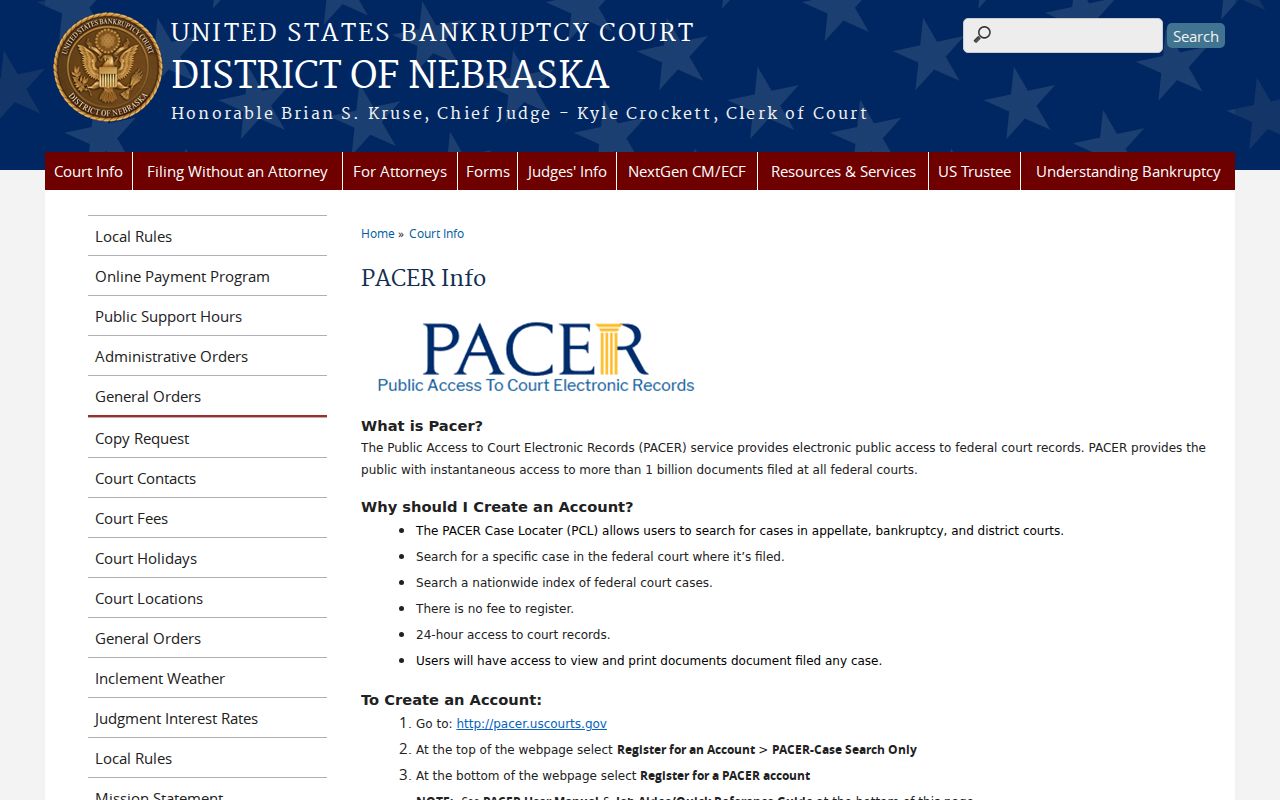
PACER only touches federal cases. It will not search Lancaster County Court or Lancaster District Court records or return copies of them. For the bankruptcy side, the federal bankruptcy court's Lincoln division page shows what that court provides.
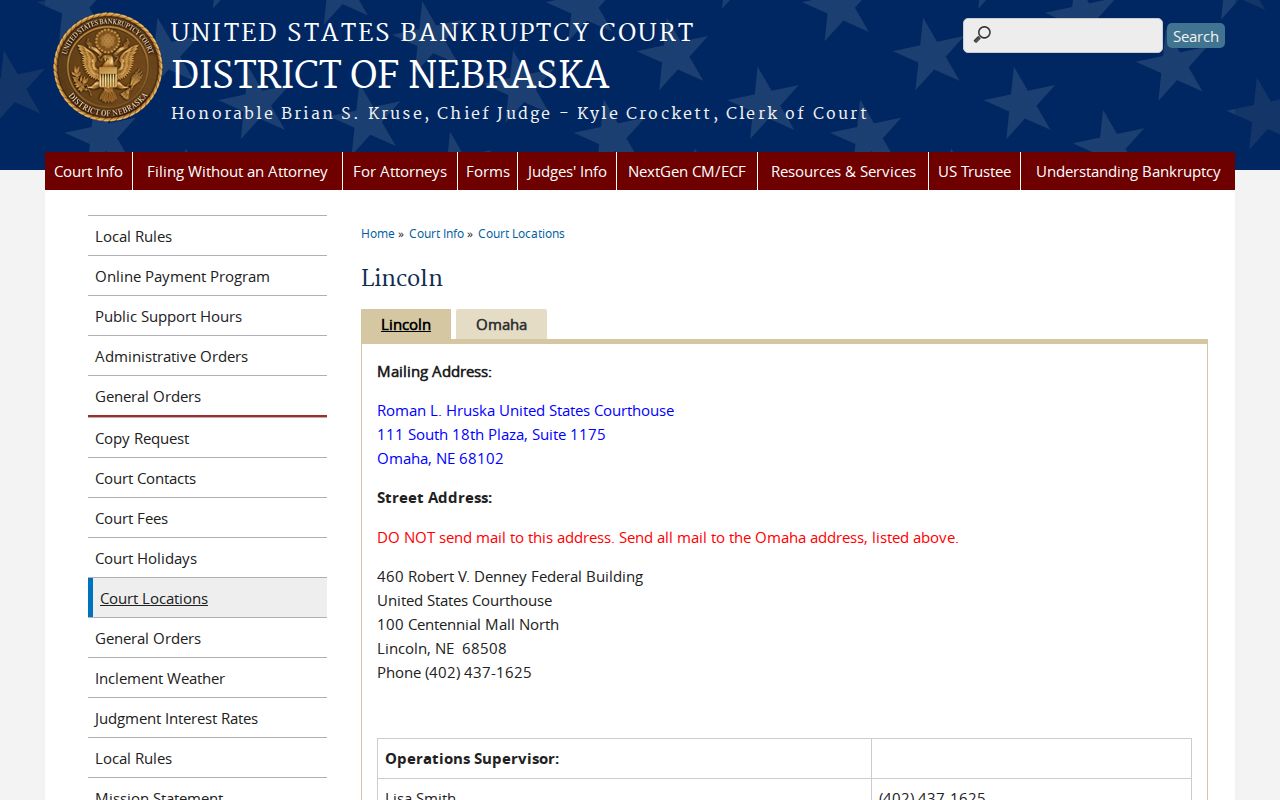
Bankruptcy records stay on that federal route. A Lancaster state or county case goes back to JUSTICE, the right clerk counter, or the specific clerk request form.
Unsure which court holds the file? Use the case number, caption, case type, and any order heading to pin down the custodian. Do this before paying for a copy. That step stops requests to the wrong clerk. It also separates a state trial record from a federal or bankruptcy matter. Make any official record request as specific as the details you have allow.